By David Western and Victor Mose
ACP commissioned the Department of Resource Surveys and Remote Sensing (DRSRS) to conduct an aerial count of the Amboseli ecosystem and surrounding areas in February. The sample count covered approximately 7800 km² of Eastern Kajiado between February 10th and February 14th, 2020. The methodology followed the same procedures and covered the same areas as counts conducted regularly by ACP since 1974.
The results of the February count are given in the table below, followed by the distribution maps for each species. The counts and standard errors for each species are given in the table alongside figures for the 2018 count to compare changes in population size.
ACP commissioned the Department of Resource Surveys and Remote Sensing (DRSRS) to conduct an aerial count of the Amboseli ecosystem and surrounding areas in February. The sample count covered approximately 7800 km² of Eastern Kajiado between February 10th and February 14th, 2020. The methodology followed the same procedures and covered the same areas as counts conducted regularly by ACP since 1974.
The results of the February count are given in the table below, followed by the distribution maps for each species. The counts and standard errors for each species are given in the table alongside figures for the 2018 count to compare changes in population size.
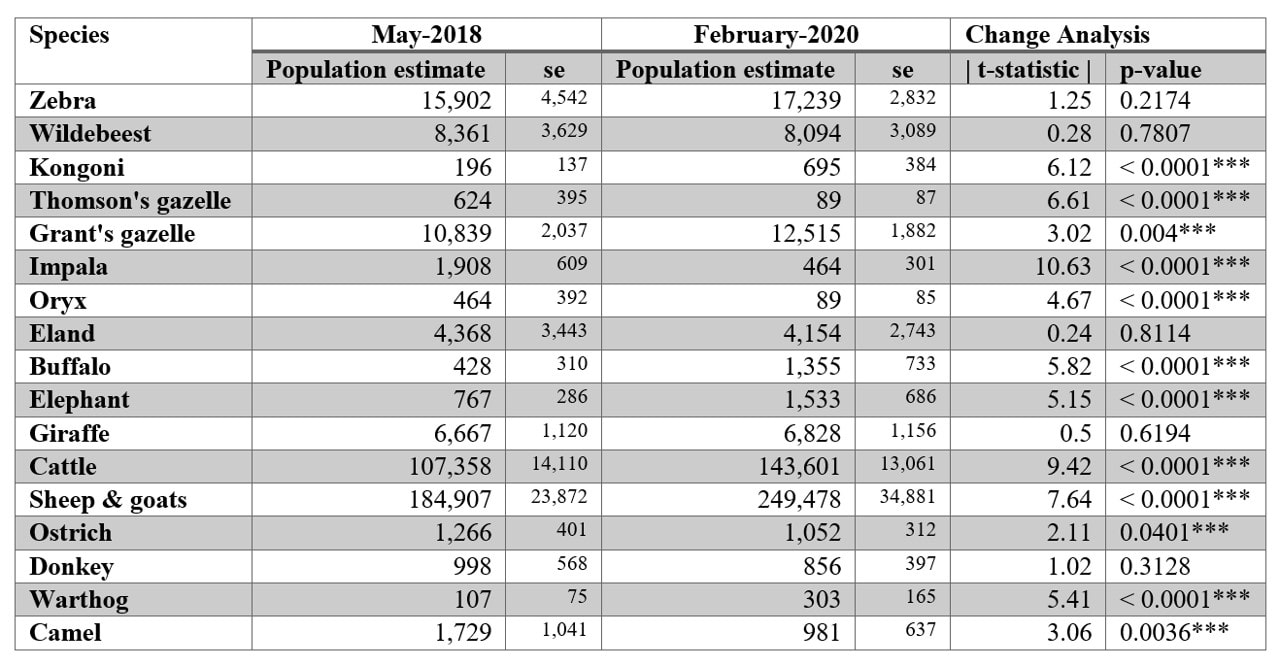
Species population numbers and standard deviations for the February 2020 aerial count of the Amboseli ecosystem and surrounding regions. Numbers for the year 2018 are given for comparisons. The starred p-values indicate significant changes in population sizes at the 95% probability level over the two-year period. (Note: These results are for conservation purposes only and cannot be included in publications without consultation)
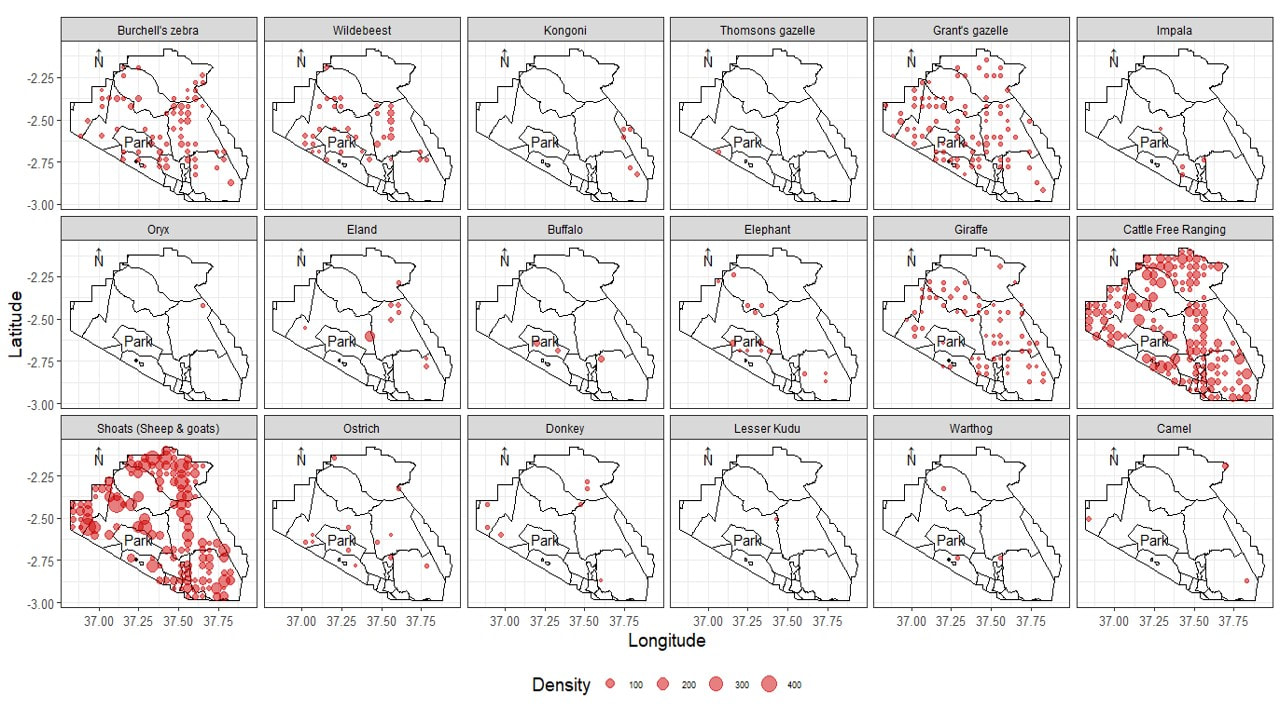
Distribution of each species tallied on the February 2020 count overlaid on a map showing Amboseli National Park and the surrounding group ranches.
We draw several conclusions and observations from a comparison of the 2018 and 2020 counts.
There have been significant increases in cattle, sheep and goats, despite the declining trends until 2018 and a sharp fall in body condition and milk yields in cattle over the past two years, as indicated by our pressure gauge index. The indications are that the higher numbers reflect livestock returning to the Amboseli ecosystem following widespread movements in search of forage during May of 2018 when the count was conducted. A similar case can be made for elephant numbers. During the dry spell of 2018, many elephants moved out of the Amboseli region in search of forage.
Increases in kongoni and warthog numbers may reflect the increased likelihood of being detected during wet rather than dry seasons. The increase in buffalo numbers may reflect the statistical quirk of hitting or missing small clustered herds in the Amboseli basin where monthly total counts record a population of 400 or so. The increase in Grants gazelle likely continues the upward trend in population over the past decade. The population sizes of Thomson's gazelle, impala, oryx, ostrich and camel are small, the standard errors large, and so the reliability of detecting actual changes over a two-year very low. ACP is currently completing a detailed analysis of the long-term trends of all species in the ecosystem to amplify the changes and causes.
Perhaps the most reassuring figures in the 2020 count are for zebra, wildebeest, eland and giraffe, the most abundance of the wildlife species. The zebra population is evidently continuing its upward trend since the severe drought of 2009 and is close to the highest peak recorded since 1974. Wildebeest, eland and giraffe populations all held stable over the past two years despite the declining pasture conditions in 2019. The giraffe result is especially gratifying. At over 6,500, the Amboseli giraffe population is among the largest in Africa and defies the rapid declines recorded across its range in the past few decades.
The long rains in April and May of 2018 were exceptionally heavy and replenished pastures across the region. However, the heavy stocking rates quickly depleted the recovery and set in motion another decline in pasture production throughout 2019 when young livestock began to die.
The torrential short rains which began in September 2019 and continued through to March 2020 have changed what was shaping up to be a severe year. The prolonged rains have pushed pasture production to a peak reached in the El Niño year of 1998. The replenished pastures provided a temporary stay on the steady decline in pasture production recorded since 2016 and will likely see a stepped recruitment in livestock and wildlife populations in the coming year. Unless, however, there is a reduction in the heavy persistent grazing pressure caused by the current large livestock populations, the pasture restoration seen in increased ground cover and forage production will revert to a downward trend by the end of 2020.
There have been significant increases in cattle, sheep and goats, despite the declining trends until 2018 and a sharp fall in body condition and milk yields in cattle over the past two years, as indicated by our pressure gauge index. The indications are that the higher numbers reflect livestock returning to the Amboseli ecosystem following widespread movements in search of forage during May of 2018 when the count was conducted. A similar case can be made for elephant numbers. During the dry spell of 2018, many elephants moved out of the Amboseli region in search of forage.
Increases in kongoni and warthog numbers may reflect the increased likelihood of being detected during wet rather than dry seasons. The increase in buffalo numbers may reflect the statistical quirk of hitting or missing small clustered herds in the Amboseli basin where monthly total counts record a population of 400 or so. The increase in Grants gazelle likely continues the upward trend in population over the past decade. The population sizes of Thomson's gazelle, impala, oryx, ostrich and camel are small, the standard errors large, and so the reliability of detecting actual changes over a two-year very low. ACP is currently completing a detailed analysis of the long-term trends of all species in the ecosystem to amplify the changes and causes.
Perhaps the most reassuring figures in the 2020 count are for zebra, wildebeest, eland and giraffe, the most abundance of the wildlife species. The zebra population is evidently continuing its upward trend since the severe drought of 2009 and is close to the highest peak recorded since 1974. Wildebeest, eland and giraffe populations all held stable over the past two years despite the declining pasture conditions in 2019. The giraffe result is especially gratifying. At over 6,500, the Amboseli giraffe population is among the largest in Africa and defies the rapid declines recorded across its range in the past few decades.
The long rains in April and May of 2018 were exceptionally heavy and replenished pastures across the region. However, the heavy stocking rates quickly depleted the recovery and set in motion another decline in pasture production throughout 2019 when young livestock began to die.
The torrential short rains which began in September 2019 and continued through to March 2020 have changed what was shaping up to be a severe year. The prolonged rains have pushed pasture production to a peak reached in the El Niño year of 1998. The replenished pastures provided a temporary stay on the steady decline in pasture production recorded since 2016 and will likely see a stepped recruitment in livestock and wildlife populations in the coming year. Unless, however, there is a reduction in the heavy persistent grazing pressure caused by the current large livestock populations, the pasture restoration seen in increased ground cover and forage production will revert to a downward trend by the end of 2020.
 RSS Feed
